
Tiles for Exterior Facades: How to Choose
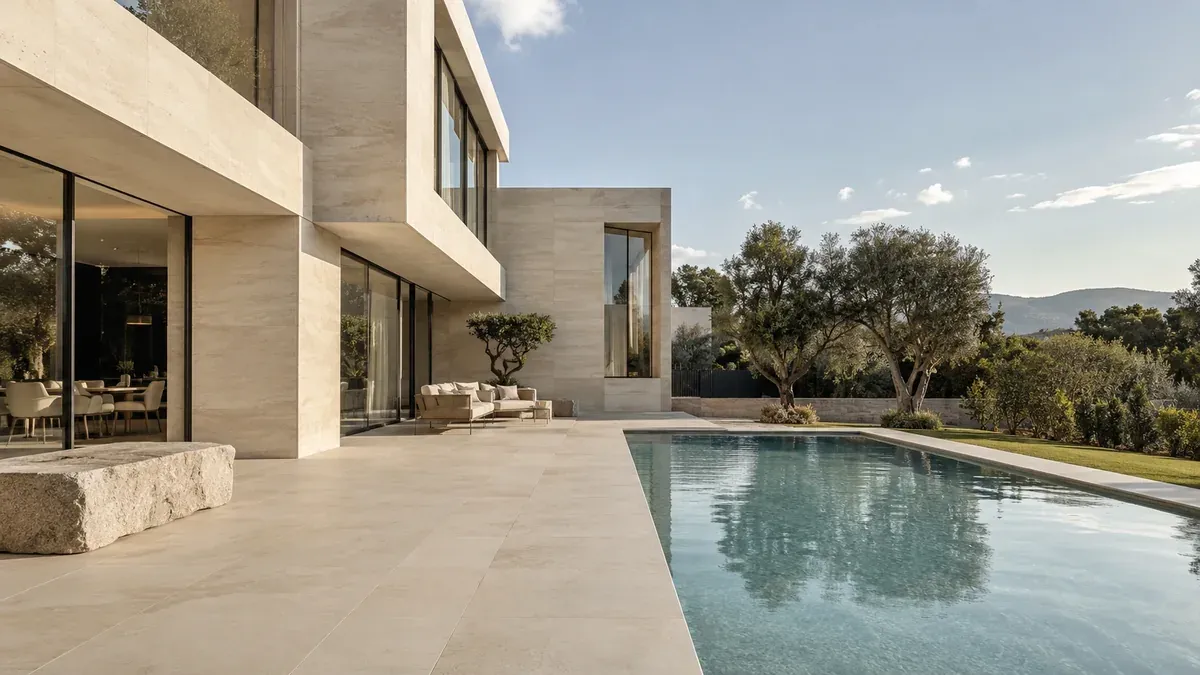
In short: for exterior facades, porcelain and clinker are the safest choices. They combine very low water absorption, strength and almost no upkeep. What decides the result is not only the look but the installation system and what the data sheet of each reference confirms.
Which materials work on a facade?
Porcelain tile
Porcelain stoneware is the usual first choice for building exteriors.
- Very low porosity. Water absorption of 0.5% or less (group BIa under EN ISO 10545-3) protects the cladding from rain and freeze-thaw cycles, on the references whose data sheet confirms it.
- Strength. It resists impact and abrasion, and it keeps its colour under UV light.
- Stability. It does not warp or crack with heat or cold.
- Cleaning. It tolerates normal cleaning products and urban pollution.
- Fire behaviour. It does not burn. Ceramic tiles are normally classified as non-combustible (Euroclass A1); check it on the data sheet.
- Large, thin panels. Modern formats cover more surface with fewer joints and less weight on the structure.
- Wide range of looks. Stone, wood, concrete, brick or metal effects, plain or textured.
Clinker and extruded ceramic
Clinker is the classic answer when the project calls for a brick look or an extra-hard surface. It is fired at high temperature, has low absorption and is used on exposed facades, plinths and commercial buildings. It comes in many glazes, textures and tones.
Red-body ceramic
Red-body tile with earth tones is decorative and works in sheltered areas. On exposed facades or in harsh climates, porcelain usually has the better technical specification.
Why tile a facade?
- Weather protection. The cladding shields the structure from rain, wind and sun.
- Durability. Porcelain and clinker last for decades with little visible wear.
- Low maintenance. Washing is enough. Wood and many renders need periodic repainting or retreatment.
- Design freedom. You can reproduce natural materials without their upkeep.
- Compatibility with modern insulation. Tile is a common finish for external insulation and ventilated systems.
Three ways to install a tiled facade
- Direct bonding. Tile is fixed to a stable brick or rendered wall with an adhesive and grout suitable for exterior use. It is fast and economical, but it adds no insulation and gives less moisture control than the other systems. Movement joints are essential.
- External thermal insulation (ETICS/EIFS). Insulation boards are fixed to the wall and finished with tile. Check that the system supplier approves tile as a finish and which formats and weights it allows.
- Ventilated facade. Tiles are mounted on a sub-frame with an air gap behind. It is the reference system for high-end and commercial buildings: it helps energy performance and lets moisture escape. It is the one that uses the thinnest and lightest porcelain panels.
Not every tile suits every system. Confirm the format, thickness and fixing method with the manufacturer’s installation guidelines before ordering.
Design effects that work outdoors
- Stone or slate look: relief surfaces with much less weight than natural stone.
- Brick or clinker look: red, sand or grey tones that suit both classic and modern buildings.
- Concrete look: a matte, urban finish without the porosity of real concrete.
- Wood look: the warmth of timber without painting, rot or warping.
- Plain colours and metallics: for contemporary buildings. Combining sizes and trims helps a facade avoid looking flat.
What to check on the data sheet
| Property | What to look for | Test standard |
|---|---|---|
| Water absorption | 0.5% or less (BIa) for the best waterproofing | EN ISO 10545-3 |
| Frost resistance | Declared as frost resistant if the building is in a cold or mountain climate | EN ISO 10545-12 |
| Breaking strength | Higher values for exposed ground floors, hail or impact | EN ISO 10545-4 |
All of these are checked against the data sheet of each reference. Dimensions, thickness and availability are confirmed per product.
Maintenance
- Wash with water and a mild cleaner. No solvents.
- For stubborn marks, use a cleaner designed for porcelain or ceramic and test it on a small area first. Avoid strong acids and metal scourers.
- Porcelain does not normally need sealing, but follow the manufacturer’s instructions for each reference.
- There is no repainting or refinishing cycle.
Common mistakes
- Choosing by appearance alone and not checking absorption and frost resistance.
- Ordering a format that the facade system does not accept.
- Forgetting movement joints and perimeter joints.
- Ordering short. Tiles from different production batches can differ slightly in shade and size, so order the full quantity at once.
Quick answers
What is the best tile for a facade in a cold climate? Porcelain with absorption of 0.5% or less and declared frost resistance. Tell us the climate and we confirm suitable references and their data sheets.
Is a ventilated facade necessary? No. It is the most efficient system, but direct bonding and ETICS are valid in the right conditions. The choice depends on the building, the climate and the budget.
What is the difference between clinker and standard ceramic? Clinker is fired at higher temperature, absorbs less water and is harder. That is why it is common on exposed facades and plinths.
Ordering tile for a facade project
Tell us the application, the climate and the installation system, and we will confirm suitable porcelain references with their data sheets, together with adhesive, grout and tools in a single proforma and a single shipment.
Request a proforma · See what we supply · Read also: What are rectified tiles?