
Rectified Tiles: What They Are and When to Use Them
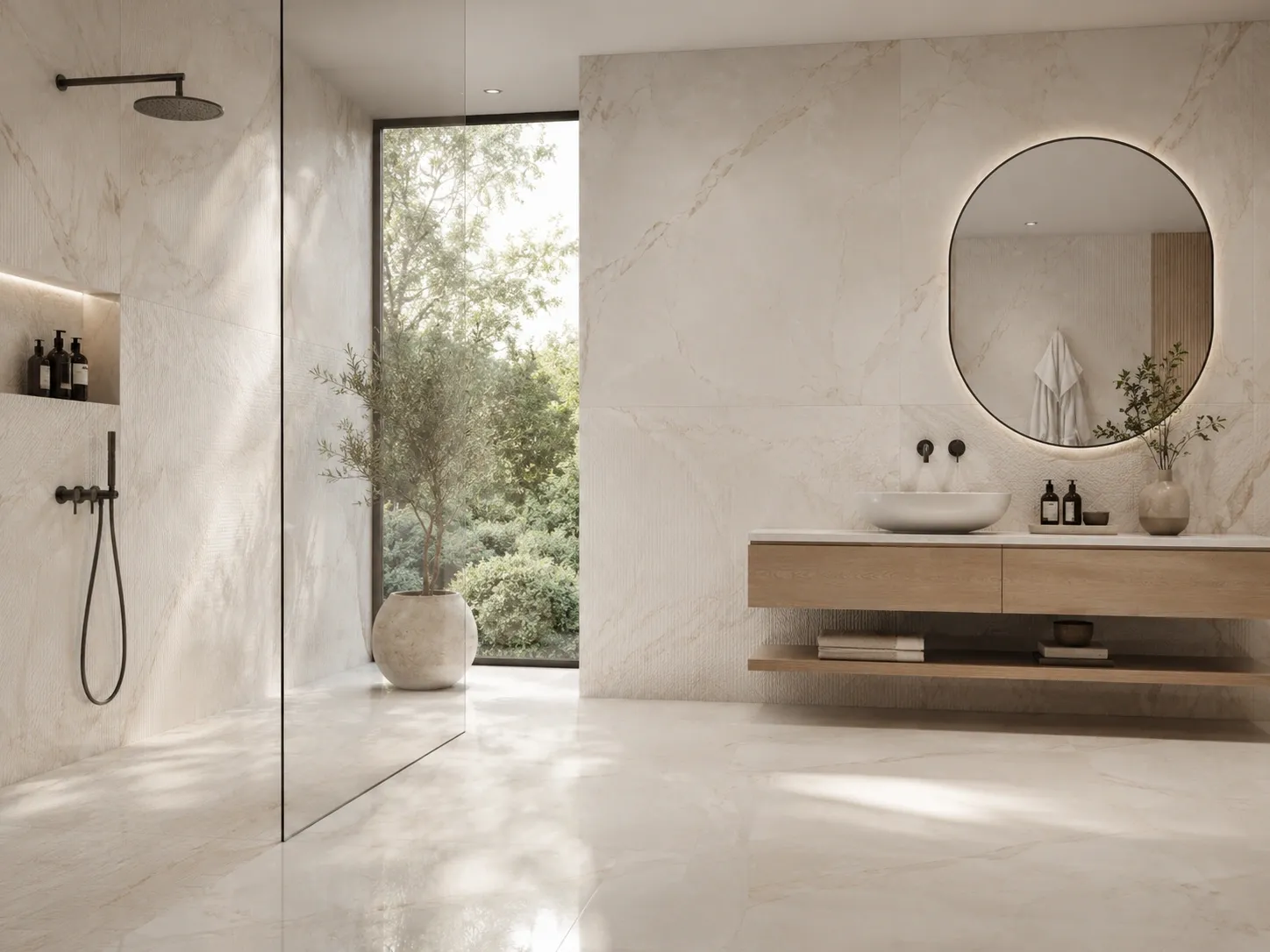
In short: a rectified tile is cut or ground after firing so that its edges are straight and its size is almost identical from tile to tile. That allows very narrow joints and a continuous, contemporary look. In return, it needs a flat substrate and careful installation.
What is a rectified tile?
Most rectified tiles are porcelain, and some are ceramic. After firing in the kiln, each tile goes through a mechanical cutting or grinding step called rectification. It corrects the small size differences that firing causes and leaves sharp edges at 90 degrees.
- Edges. Straight and sharply cut, sometimes with a very small bevel. Non-rectified tiles have rounded or moulded edges.
- Uniformity. The size variation within a batch is minimal, so the tiles fit in tight, straight lines.
Where are they used?
- Interiors. Living areas, kitchens, bathrooms, hotel lobbies and commercial spaces. With narrow joints, marble, stone or wood patterns look nearly uninterrupted.
- Exteriors. Terraces, patios and pool surrounds, as long as the reference is rated for exterior use and has a suitable slip resistance for the area. Its use outdoors depends on the product, not on rectification itself.
- Large formats. Tiles above roughly 60 cm are usually rectified, because tight joints and a flat surface matter more as the format grows.
Advantages
- Clean, modern look. Uniform size and sharp edges.
- Discreet joints. Less visible grout gives a minimalist effect.
- Design flexibility. Large formats and straight layouts work better with a precise size.
- Easier cleaning. Less joint area means fewer places for dirt to collect.
Points to consider
- The substrate must be flat. With narrow joints, irregularities in the base are not hidden, and lippage (one tile standing higher than its neighbour) is easier to see.
- Cost. Rectified tile and its installation usually cost more than non-rectified tile, because of the extra processing and the skilled labour required. Each project is different, and the proforma shows the actual figures.
- A joint is always needed. Even the narrowest joint has a job: it absorbs the small movements caused by temperature and humidity. Tiles should never be butted together.
Rectified versus non-rectified
| Feature | Rectified | Non-rectified |
|---|---|---|
| Edges | Straight, sharp | Rounded or moulded |
| Size variation | Minimal | Wider |
| Joint | Narrow (check the manufacturer’s minimum) | Wider, to compensate for the variation |
| Look | Seamless, contemporary | Rustic, handmade character |
| Installation | Demanding | More tolerant |
How narrow can the joint be?
It depends on the product and on the manufacturer’s installation guide. Many rectified tiles are laid with joints of around 2 mm, and some references allow 1.5 mm. A joint of zero is not recommended. The data sheet and the installation guide of each reference give the minimum.
Tips for a good installation
- Prepare the substrate. It should be flat, stable and clean. A tolerance check before the tiles arrive saves problems later.
- Use a suitable adhesive. Choose a high-performance adhesive suited to porcelain and to the format.
- Use fixed spacers of the width recommended for the product, and a levelling system on large formats.
- Choose a fine grout in a tone close to the tile.
- Leave movement joints at perimeters and changes of plane.
- Use experienced tilers. Rectified tile leaves very little room for correction.
Maintenance
Because there is little joint and porcelain is dense, cleaning is simple: sweep or vacuum, and mop with a mild, non-abrasive detergent. The joints need occasional attention.
Frequent questions
Can rectified tiles be used outdoors? Yes, if the reference is designed for exteriors and has the right slip resistance and frost resistance for the climate. Check the data sheet.
What happens if a corner chips? Sharp edges can chip in transport or installation. Small chips may be hidden by the grout; a badly damaged tile is replaced. Handling the pallets and boxes carefully reduces the risk.
Do I need a professional installer? For a flawless result, yes, particularly in large formats.
Choosing rectified tile for a project
If you are specifying large formats or want a seamless look, rectified tile is usually the right choice. Tell us the format, the application and the destination, and we confirm suitable references with their data sheets, together with adhesive, grout, spacers and tools in a single proforma and a single shipment.
Request a proforma · See what we supply · Read also: Tiles for exterior facades